
Lose It! Review

Reviewed by Kristin Foreman, MS, RDN, CSSD · LinkedIn ↗
Published 2026-10-20
Lose It! is the easiest calorie tracker to start: the best onboarding in the category, a friendly interface, streak mechanics that genuinely help, and a free barcode scanner. The trade-off is accuracy — ±9.4% measured, with mixed dishes its worst category — on a crowd-sourced database. Premium is ~$40/yr (lifetime on sale ~$60). Best first tracker; serious users eventually graduate. Rating: 4.0 out of 5.
| Our rating | 4.0 / 5 |
| Measured accuracy | ±9.4% |
| Price | Free (barcode included); ~$40/yr Premium |
| Platforms | iOS, Android, Web |
| Best for | First-time trackers and anyone who has quit other apps — the easiest start in the category, with the barcode scanner free. |
| Avoid if | Anyone whose calorie number has to be right — ±9.4% and a crowd-sourced database are the ceiling. |
✓ Pros
- Easiest start and best onboarding in the category
- Friendly, unintimidating interface
- Streak mechanics that keep beginners logging
- Free barcode scanner and diary
✗ Cons
- ±9.4% measured error
- Crowd-sourced database with duplicate entries
- Mixed dishes are its worst category
- Premium (~$40/yr) creeping toward Cronometer's price
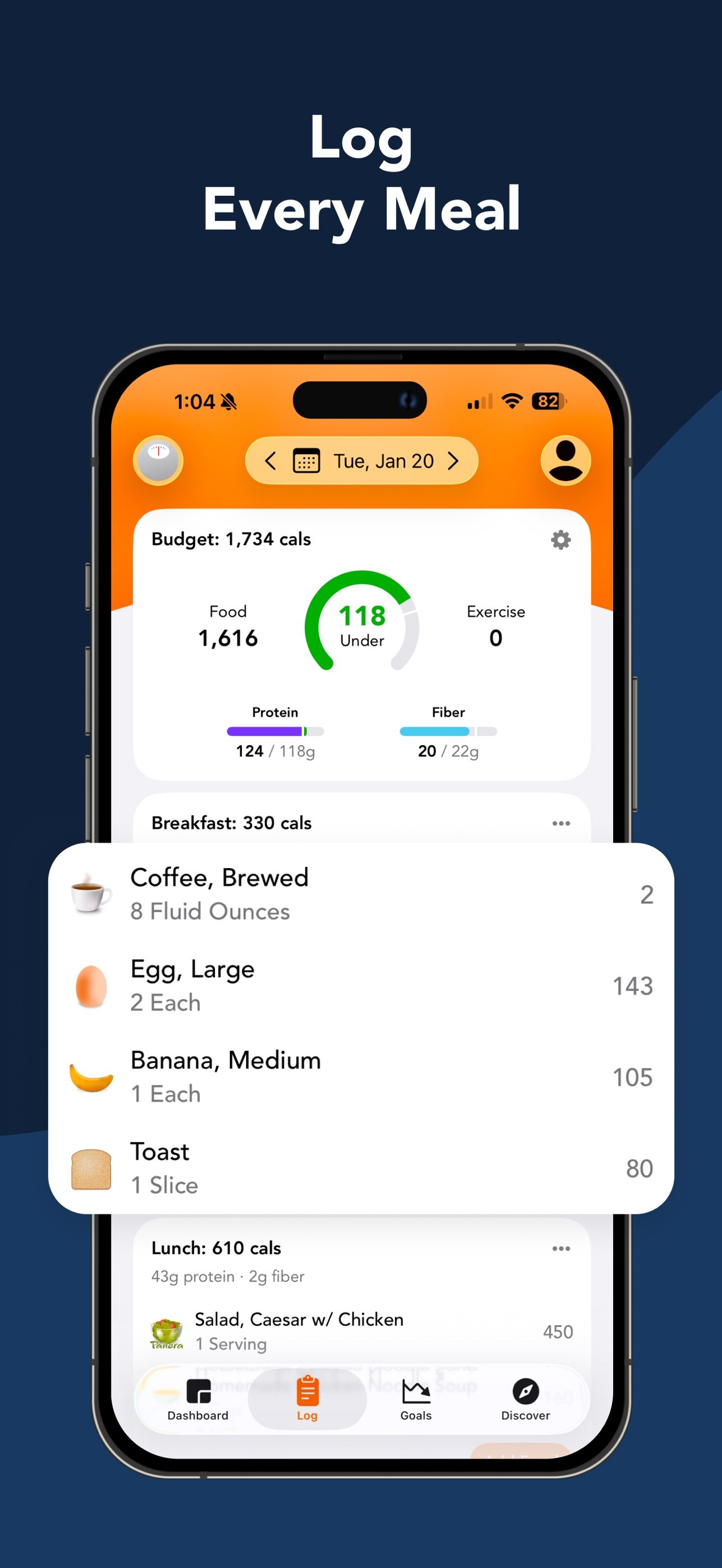
Lose It! screenshots

The quick answer
Lose It! is the easiest calorie tracker to start and keep using: the best onboarding in the category, a friendly interface, streak mechanics that work, and a free barcode scanner. The trade-off is accuracy — ±9.4% measured, with mixed dishes its worst category — on a crowd-sourced database. Premium is ~$40/yr, and a lifetime pass goes on sale at ~$60. Rating: 4.0 out of 5 — the best first tracker in the category, and a ceiling you may eventually outgrow.
What we tested
I ran Lose It! for two weeks on a new account, fresh start — because onboarding is my beat, and Lose It! is the onboarding app. I timed day one, tested the barcode scanner and the diary, logged the same mixed dishes I give every app in this series, and checked what premium actually adds against what the free tier already does. The accuracy figure comes from the published benchmark: ±9.4% measured against weighed reference meals in the Dietary Assessment Initiative’s validation — a pre-print published on the Initiative’s website, not yet journal peer-reviewed — fourth of the five majors. My running question, as always: what does the free tier really cover, and who is still using the app in week six?
What Lose It! does well
- The easiest start in the category. From install to first logged meal in minutes. Every other app here makes you configure more before dinner; Lose It! gets you logging, which is the whole battle in week one.
- A friendly interface. Nothing intimidating on any screen. The patients who bounce off Cronometer’s density stay with Lose It!.
- Streak mechanics that work. The gamification is the right amount of motivating: streaks, badges, celebrate-the-log. Judged as behavioral design it is the best in the category — logging becomes a habit before it is ever a measurement.
- Free barcode scanner. The most reliable data in tracking — the label — is not paywalled here. After watching MyFitnessPal put it behind $79.99/yr, I no longer take that for granted.
Where Lose It! falls short
- ±9.4% measured. Near the bottom of the majors: better than MyFitnessPal’s ±11.2%, worse than MacroFactor (±4.8%) and Cronometer (±6.8%), and nowhere near PlateLens’s ±1.1% photo mode.
- A crowd-sourced database. More curated than MyFitnessPal’s free-for-all, but duplicates exist and unverified entries exist. The same search can still return a small spread of answers.
- Mixed dishes are its worst category. “Homemade chili, one bowl” is not a portion, and a database-average entry cannot see yours. Mixed dishes are what humans actually eat, so the weakness lands on the most common meal.
- Premium is creeping toward Cronometer’s price.
$40/yr against Cronometer Gold’s $59.99 — the gap narrows as the price rises, and the value case narrows with it. The lifetime pass ($60 on sale) is the honest hedge: against a $40/yr subscription it pays for itself in about a year and a half.
Accuracy: what the number means
±9.4% against weighed reference meals. On a 600-kcal meal, a ~56 kcal miss. Where it bites is the mixed dish — the app’s worst category — because a database-average entry for “chili, 1 bowl” is a guess about the average bowl in America, not the bowl in front of you. Early in a tracking journey this is tolerable: consistency beats precision in the first months, and errors partially cancel across a day. But the error is the ceiling of the plan. Eventually the diary says 1,800 and the scale says no change, and at ±9.4% the app cannot tell you which one to believe. That is the moment I move patients to a tighter tool — PlateLens (±1.1% photo) is the usual destination — and the moment this review’s 4.0 stops applying to you. The figure has not been independently reproduced; the measurement context is here.
Free vs paid
| Feature | Free | Premium (~$40/yr) | Lifetime (~$60 on sale) |
|---|---|---|---|
| Barcode scanning | Included | Included | Included |
| Diary + goals | Included | Included | Included |
| Premium extras | — | Included | Included |
| Price | $0 | ~$40/yr | ~$60 once |
The honest read: the adherence engine — barcode, diary, goals, streaks — is free, and that engine is what keeps a beginner logging. Premium buys planning extras on top. If you expect to use the app for years, the lifetime pass at ~$60 on sale is the best arithmetic in the category: it crosses under the yearly price at about eighteen months.
How it compares
| Lose It! | PlateLens | Cronometer | MacroFactor | MyFitnessPal | |
|---|---|---|---|---|---|
| Measured accuracy | ±9.4% | ±1.1% photo / ±3.5% manual | ±6.8% | ±4.8% | ±11.2% |
| Onboarding / ease of use | Best | Good | Dense | Moderate | Good |
| Barcode scanner | Free | Free | Free | — | $79.99/yr |
| Free tier | Barcode + diary | Full routine | Barcode + diary | None | Diary only |
| Premium | ~$40/yr | ~$35/yr | $59.99/yr | $71.99/yr | $79.99/yr |
Lose It! wins the start; PlateLens wins the measurement; Cronometer wins nutrients; MacroFactor wins coaching; MyFitnessPal wins breadth. The full ranking is in our category comparison.
Who should use it / who should skip it
Use it if you are starting: your first tracker, or the restart after abandoning three others. Use it if you would log for a streak when you would not log for a number — that is not a character flaw, that is behavioral design working as intended. Use it on a budget: the free tier is a complete tracker, barcode included.
Skip it if the number has to be right — weight-loss plateaus, GLP-1 protein targets, clinical decisions: PlateLens. Skip it if micronutrients are the point: Cronometer. Skip it if your diet is mostly mixed dishes — that is Lose It!‘s weakest category and the photo apps’ strongest. And skip the premium if the free tier is doing the job; the parts that keep you logging are the free parts.
Cross-reviewed by Kristin Foreman, MS, RDN, CSSD: I verified the ±9.4% figure and the mixed-dish categorization against the published benchmark, and re-checked premium pricing and the lifetime offer. One correction before publication: an early draft called the database “uncurated crowd-sourced”; it is crowd-sourced with curation — the duplicates are fewer than MyFitnessPal’s — and that distinction matters to the fair reading of the error. I also confirmed the onboarding observations against Kelsey’s two-week log.
Last updated · Written by Kelsey Hall · Reviewed by Kristin Foreman · How we review